

Listen to “Dé(s)connexions” for a fresh perspective
In this new monthly series, we’re giving experts a platform to explore topics that resonate with our professions and our daily lives.

“A train station is meant to bring people together”
How can we design spaces that are both welcoming and make people feel at home? That’s the question explored by Constance Guisset—designer, interior architect, and scenographer— in this first episode of our podcast.
Known for her work on living and working spaces at the Théâtre des Champs-Elysées, the National Institute of Art History, and the Villa Medici in Rome, Constance Guisset reflects on the etymology of the verb accueillir—a word that holds particular meaning for her. While it translates roughly as “to welcome”in English, its roots in Latin and old French evoke gathering, connecting and bringing people together.
According to Guisset, public spaces such as train stations—which fill up, then empty out repeatedly over the course of a single day, should not function merely as places of transit. Through their beauty and comfort, they should also encourage people to linger, meet and feel at ease.

"Being true to oneself "
Is the workplace welcoming to LGBT+ people? How can we create a safe environment for all employees where everyone can be themselves? How can inclusion help nurture change in the SNCF Group?
Following the International Day Against Homophobia, Transphobia and Biphobia on May 17, and on the eve of Pride Month, Ali Louni, President of Gare!, SNCF Group’s LGBT+ association, shares his personal journey and explains what mad him an advocate for the inclusion of LGBT+ people. He also discusses whether discrimination has really lessened in the SNCF Group and in France, and emphasizes the importance of showing that members of the LGBT+ community are welcome at stations and on trains.

"AI: a user's guide"
How is the workplace embracing AI? For which tasks does it prove most useful? Which decisions should, in principle, be entirely left to humans? Why should we carefully consider how we use AI, including in our personal life?
Just as the VivaTech trade show took place on June 17–20 in Paris, Gilles Moyse—president and co-founder of réciTAL, a company that develops an automated document processing platform, and holder of a Ph.D. in Artificial Intelligence—looks back at the history of AI, from the Turing machine to ChatGPT, and helps us ask the right questions. This talk helps us move past the narratives expressing feelings either of wonder or of doom concerning what this innovation, already a big part of our lives, will bring about.
“Changing workspaces and finding new ways of working”
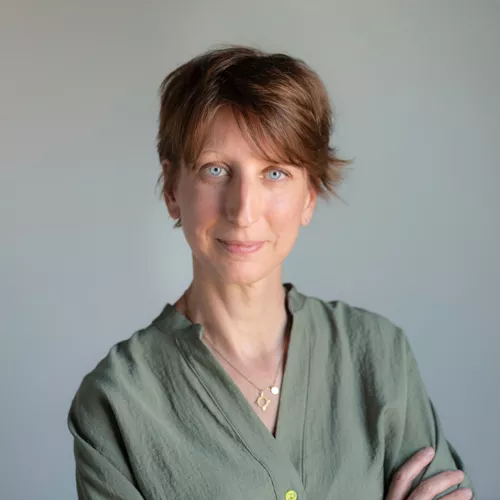
What do French people want their workplace to be like nowadays? When they're asked about their expectations, they mention the need for space as well as privacy, the opportunity to interact with colleagues, natural light, and so on.
Interior designer and consultant Hélène Vandevyver works with companies aiming to bring employees back to the office and rebuild social connections by transforming their workplace. In particular, she explains why she's adamant about the concept of a “dynamic environment”, which is unlike a “flex-office”. Each work team may use a well-defined area within the building—a home base and spaces tailored to its needs and uses. This type of environment addresses companies’ challenges by making the office a place of cohesion and resources—in short, a place where people feel comfortable.
"Designing the train station of 2050"
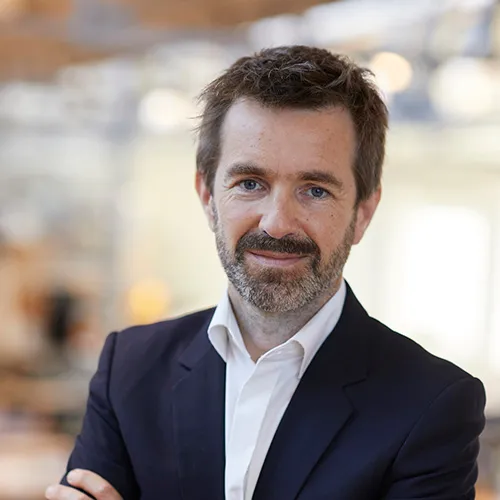
What will the train station of the future look like? How can we design a train station that is at once useful, low-carbon and beautiful? To mark European Heritage Days, Raphaël Ménard, president of AREP—a subsidiary of SNCF Gares & Connexions dedicated to design— introduces his vision of the train station of the future.
In the face of climate change, urban planning, architecture, and design must adapt to global warming and its effects; however the limits set by the ecological transition may serve as a creative framework. This is at the basis of the EMC2B (for energy, materials, carbon, climate, and biodiversity) approach developed by AREP to design sustainable projects.

"Managing your stress"
How can we manage our daily stress? What’s the easiest way to recharge one's batteries? How can we boost our production of oxytocin, also called the “happiness hormone”? Let's hear from a consultant who specializes in stress management. Ariane Oclin gives out some tips in order to help us come to terms with our stress, which is in fact a simple reaction of our brain when we are faced with changes in our environment.
Taking a step back and looking at the situation from a different perspective, here is a very effective mental exercise which helps reducing your stress levels. And to let go, there’s nothing like recharging your batteries— why not take a walk outside to breathe in soothing phytoncides, or practice deep breathing?
Episodes [all interviews are in French]
- November 2026:
“Disability” with Eric Chenut, president of the French National Federation of Mutual Insurance - December 2026:
“Creating a new local presence” - January 2027:
“Seniors and inclusion” with Sibylle Le Maire, founder of Club Landoy
Share the article