

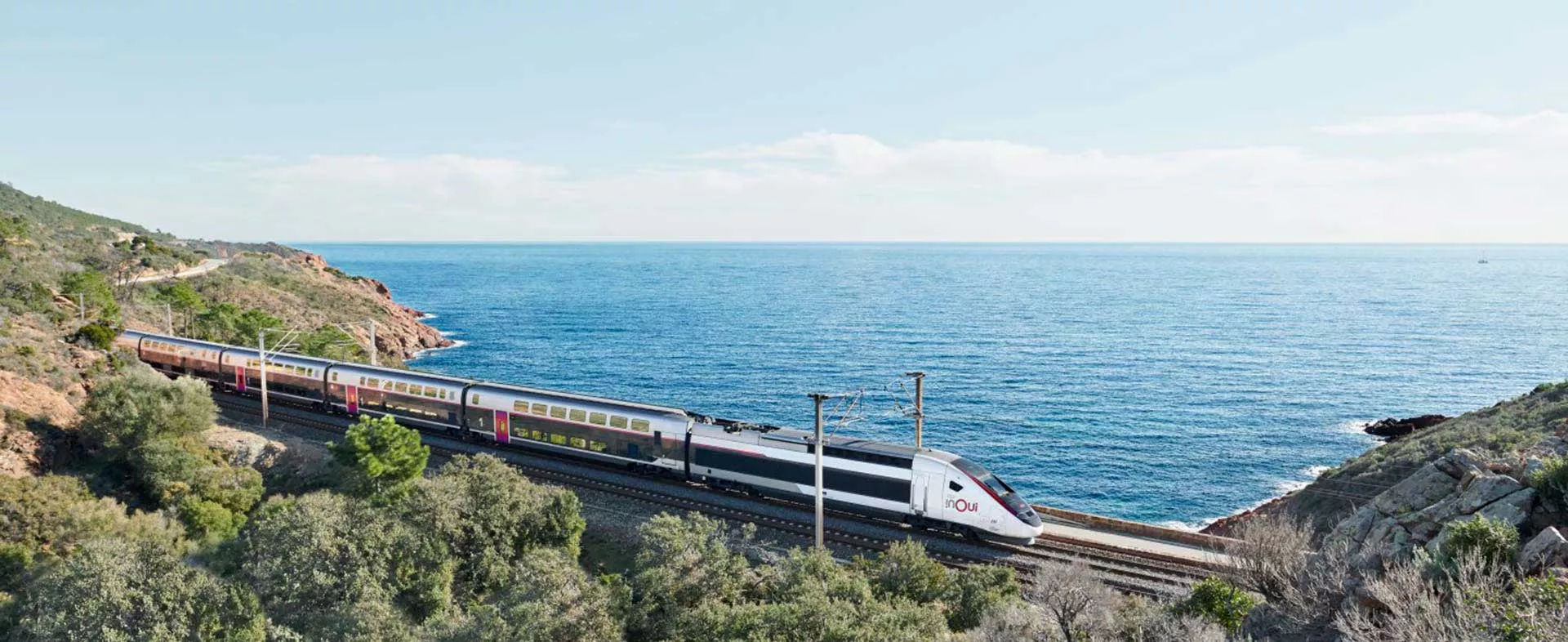
Our proposals for the future of European rail
Discover SNCF Group’s manifesto, released in the run-up to Europe’s 2024 elections. It calls for making the shift to rail a core policy priority across the continent.
SNCF Group manifesto
DOCUMENT
EnglishPDF • 5.1MB
Download SNCF Group manifesto - English - pdf - 5.1MBGiving fresh momentum to European transport policy
The European elections on June 9, 2024 renewed the 720 members of the European Parliament, including 81 representatives from France. On this occasion, and following consultations with its stakeholders, SNCF Group and its entities—freight and passenger operators as well as infrastructure managers—prepared a Manifesto outlining ideas and concrete proposals to revitalize European transport policy and accelerate the sector’s decarbonization.

Around
25%
of the European Union’s CO2 emissions come from transport

Only
0.4%
of these emissions come from rail
We call for
doubling
rail’s share of freight and passenger transport by 2040

“Rail must become a centrepiece of decarbonization”
“Rail consumes less energy and has lower greenhouse gas emissions than any other mode of transport. It must become a centrepiece of transport decarbonization policy, and a top priority for the next European Commission. Without modal shift, Europe will not reach its emission reduction goals.”
Jean-Pierre Farandou, former Chairman and CEO of SNCF Group (2019-2025)
5 priorities
1. Level the playing field
All external costs for transport operations must be internalized, so prices reflect each mode’s true cost to society. This is the only way to create fairer competition.
How to get there
- Require carriers to inform shippers and passengers of the external costs of transport, starting with greenhouse gas emissions.
- Accelerate revision of the Energy Taxation Directive to make fuel taxes more equitable.
- Make road use charges more equitable and include external costs.
- Exempt international passenger rail transport from VAT uniformly across the EU, as is the case for air transport
2. Provide enough funding to meet the challenge
To meet our modal shift targets, rail networks must be improved, updated, and even expanded, which will require massive investments. We believe it is essential to increase the amount of European funding allocated to rail infrastructure through contributions from the biggest polluters in the transport sector.
How to get there
- Quintuple the amount for the Connecting Europe Facility (CEF).
- Allocate some of the resources from the ETS1 and ETS21 emissions trading systems to rail infrastructure.
- Allocate a substantial share of road use charges to rail.
3. Create a positive supply shock in passenger transport
Europe won’t achieve modal shift in passenger transport without persuading a significant number of people to change their habits. Increasing supply is one of the best ways to do it. But for this strategy to succeed, infrastructure must be upgraded, and the rail sector must reimagine itself to offer services even more attuned to passenger expectations. The EU regulatory framework can help.
How to get there
- Set prices that accurately reflect the external costs that each transport mode imposes on society.
- For international night trains, create European public service contracts and fund them at European level.
4. Stimulate shipper demand
We can’t reach modal shift in freight transport without persuading more shippers to choose rail, primarily as a substitute for road. To stimulate shipper demand, the key drivers are reliability, traceability, the intermodal terminal offer, pricing, on-time performance and cargo capacity. But putting these drivers to work requires progress on 3 fronts: fair competition between transport modes, improvements in capacity and infrastructure, and targeted aid and regulatory incentives.
How to get there
- Set prices that accurately reflect the external costs of transport.
- Develop investments that will allow rail freight to grow.
- Scale up combined transport massively, by enhancing tax and regulatory incentives, and prevent the rise of mega trucks.
- Create a public service obligation for freight and leave room for state aid.
5. Create a favourable regulatory environment for modal shift
In coming years, the rail sector must innovate to become the most competitive transport mode and carry out a wide range of projects to improve interoperability at European level. These efforts should be the priority for the sector’s limited human and financial resources.
How to get there
- Eliminate proposed laws and regulations that are not essential to meeting modal shift targets.
- For interoperability and technical harmonization: focus updates to technical specifications for interoperability (TSIs) on essentials; simplify the train certification process; and continue to equip the entire fleet with ERTMS.
- Place more reliance on the skills and experience of SNCF and other legacy rail players to grow the entire sector.