

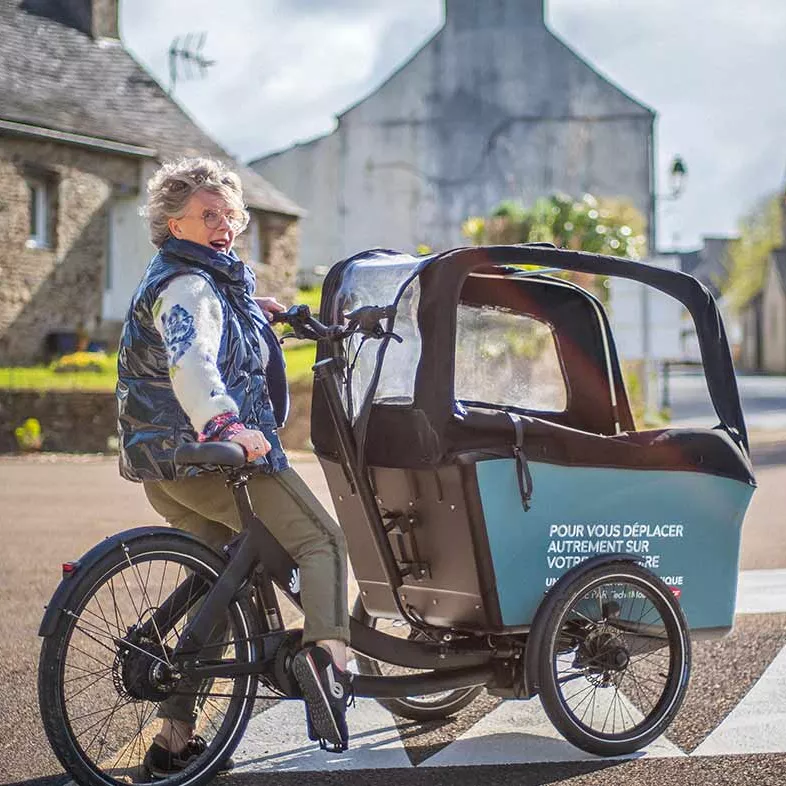
Our Mobility Stations: promoting shared mobility in the countryside
How can we encourage people to use active, shared mobility solutions in rural communities? That’s one of the challenges addressed by mobility stations, an experiment launched by SNCF Tech4Mobility which was awarded a special prize for local innovation at the 2024 exhibition for mayors and local authorities. The team in charge explains to us this project.
SNCF’s innovation accelerator Tech4Mobility designed our Mobility Stations as eye-catching landmarks to spark interest in shared and active transport solutions. Carving out a more visible space is key. Two experiments were conducted in western Brittany, both aimed at encouraging local residents to shift from private cars to bicycles, car sharing and other mobilities. Caroline Guérin, Project Lead for the department’s Innovation by Design initiative, explains how these innovative solutions—which were awarded a special prize in the “low-carbon mobility” category at France’s 2024 exhibition for mayors and local authorities—came about.
How did the Mobility Stations project get started?
Caroline Guérin: While testing transport-on-demand initiatives, our innovation accelerator Tech4Mobility found that non-city dwellers were far less inclined to shift from private cars to more affordable, shared and collective modes of transport—and that we would need to find ways to encourage that change in their communities. To make these new forms of mobility more appealing, we took a fresh look at street furniture. In cities, urban furniture draws residents’ attention to scooters and car sharing, not to mention buses and metros. But in rural areas, street furniture is either non-existent or a throwback to the 1970s—think concrete bollards, or wooden and plexiglass bus shelters for school children.
So, there was nothing alerting rural communities to these new forms of mobility?
Caroline Guérin: Exactly. So we set out to invent a new rural equivalent—eye-catching street furniture that would spotlight these new solutions for local communities. A simple transposition—copying and pasting urban solutions into rural settings—wouldn’t work because the social codes are different. But when people pass by street furniture designed especially for them every day, they notice and get used to new transport options. For example, bikes for shared use—cargo and longtail bikes, and bike-buses for school runs. Or shared electric vehicles that don’t require a driver’s license. Following our gut feeling, we turned to the cognitive and behavioural sciences to create what are called cognitive cues1—visual signs that make mobility a realistic option in a given environment. We trialed this in Guimiliau and Plouzévédé, two towns in western Brittany.
Why those towns?
Caroline Guérin: We headed into the field with AREP2, whose teams worked with us on furniture design. We chose around 15 sites and shortlisted candidates using a grid that assessed issues like safety, space requirements, proximity to popular local destinations, and so on. Then we worked with Kisio3 on how to set up and run the test across the full range of mobility services.
How did you tackle furniture design?
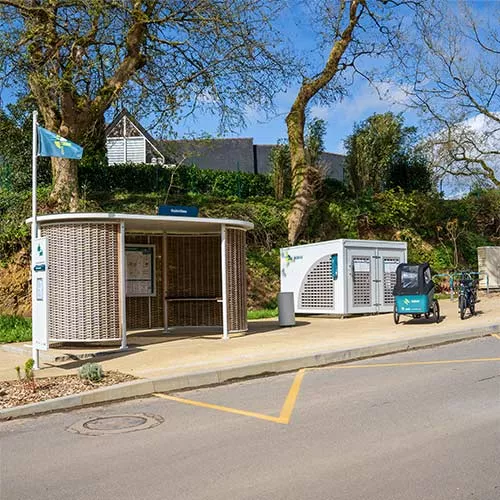
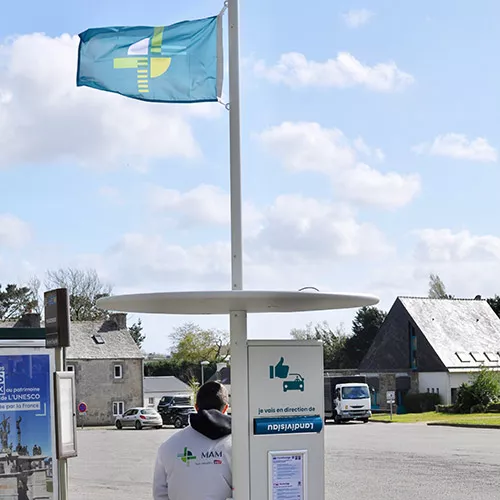
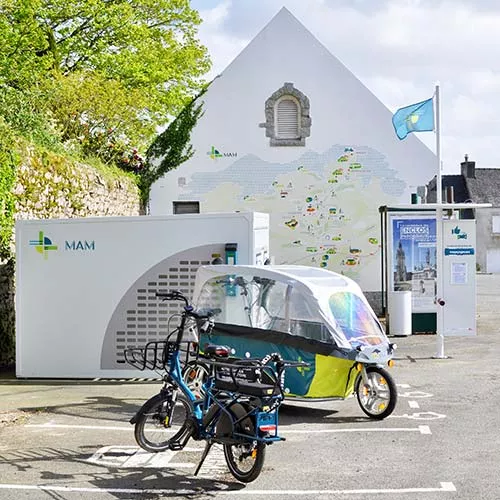
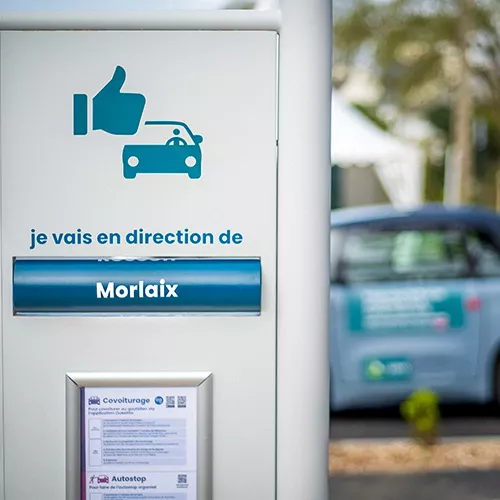
Caroline Guérin: Our aim, working with AREP Design, was to create new street furniture that had a distinct feel and identity suited to how these mobility options would be used. We worked on “affordance”, a design concept in which the properties of an object make it naturally user-friendly—When people see it, they intuitively know how to use it. For example, our flagpoles have a “destination scroll” making it clear this is the spot for hitchhiking and car sharing. Our shelters support a variety of mobility modes, with bike racks, custom-made secure lockers, bike pump and repair stations—in short, all the services and options you would expect to find at a Mobility Station.
How do your designs differ from urban furniture?
Caroline Guérin: To make our markers both recognizable and attractive, we updated existing rural codes and created a new identity. Example: our flagpole harks back to May Poles that people once decorated with bouquets or pennants. And we use materials that evoke farming and agriculture—galvanized steel, but also wood, in reference to rural communities’ long tradition of woodworking. Which means that markers can be customized for each region.
For example?
Caroline Guérin: The shelter in Guimiliau houses a range of services—above and beyond those that we offer. And it’s a hybrid creation that combines industry and craft: we teamed up with a local wickerwork specialist who wove materials onto a metal frame for the side panels to create a comfortable waiting area.
How does the hitchhiking and car-sharing pole work?
Caroline Guérin: We were keen to develop low-tech solutions here—furniture that’s both low-maintenance and sustainable. For hitchhiking stops, a “destination scroll” replaces the hitchhiker’s traditional hand-drawn sign. If someone is waiting for a ride, they push a button that activates a signal light. By designating an official ride-share spot, this system encourages safe hitchhiking. In Plouzévédé, the pole even has its own power source—solar panels on the roof. We’ve also designed user-friendly ways of letting people know what options are available.
What kind of devices did you use?
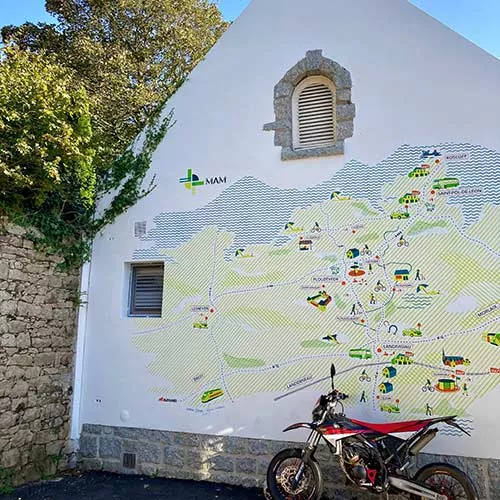
Caroline Guérin: We started with simple tools, like maps. Many people in rural areas aren’t familiar with public transport, since most rely on private cars. So we need to show potential users what’s available—how they can get around their region without having to decipher the timetables for each operator or navigate endless maps. Our solution: collect this information and share it through local government so people can easily see all the shared and collective mobility options in their area. In each community, we’ve also used maps to highlight everyday destinations—from the town hall and sport facilities to the bakery—located within a short radius of the new street furniture. It’s a simple way of showing that these trips don’t require a car. Ultimately, it’s about explaining how to get from A to B—on foot, by bicycle, by electric bike—and how long it will take, so people realize just how easy it is.
We showed that you don’t need a car for short, everyday trips.
So what alternative mobility solutions are on offer?
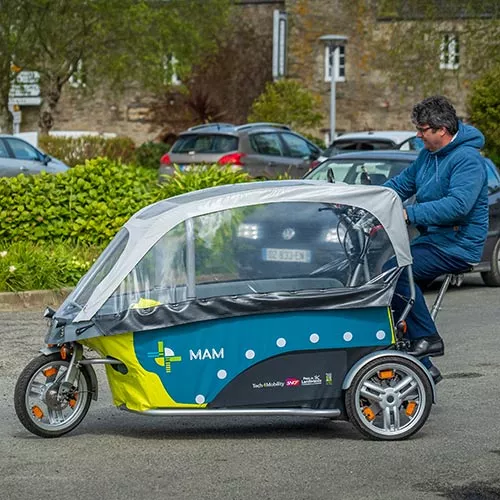
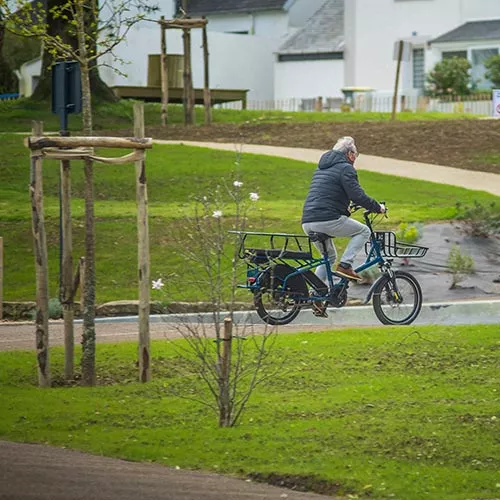
Caroline Guérin: Our aim was to offer local residents new forms of mobility as an alternative to private cars. First, there’s a stock of “local bikes” donated by residents who no longer use them. We repair these and put them back into circulation free of charge, for anyone who needs one. But there are also longtails and cargo bikes for heavy loads, and even a bike-bus for up to eight children. That’s ideal for school transport or group outings. Plus electric mini-vehicles that don’t require a driver’s license. And there’s car-sharing and hitchhiking. Users can find the solution that suits them best.
What about passenger information?
Caroline Guérin: Mobility Stations bring all mobility services together in one place. Our focus is accessibility, suggesting ways to use all these solutions, setting out the distances each one can cover, explaining how much they cost, and so on. All of this information is displayed on panels near the furniture, but also in town halls which help spread the word.
So it’s a multi-pronged initiative?
Caroline Guérin: Yes. We’re reaching out to all kinds of people, particularly those who need to get around but can’t—seniors, for example, or young people who don’t have a driver’s license. These “housebound” groups don’t always have the financial or physical means they need to get out and about. We want to include them as much as possible, and our service offers an app and a website where residents can reserve bikes or mini-cars. For people who are less comfortable with digital technology, we’ve set up a customer service department.
What role did the two host towns play?
Caroline Guérin: We began by holding workshops with local officials, residents, associations and businesses to learn about local mobility habits and brainstorm together on what an ideal Mobility Station site would look like. It was collaborative, a co-build process to encourage local communities to buy into our solution. The network of local authorities was always there to relay our messages out into the community. That’s no small challenge, so we also relied on support from the town halls and their municipal teams. Our street furniture is installed on public land, which meant signing agreements with the authorities to occupy those sites. All this meant that we forged closer ties with both towns than if we had focused solely on delivering transport-on-demand or bike services.
What feedback have you had from residents?
Caroline Guérin: They love it! Events organized to celebrate the launch played a key role: we brought in residents, helped them set up their online accounts and test our custom bikes and cars, and trained local municipal teams—all of which paid off. We’ve got to keep promoting our Mobility Stations and organizing events like those to spread the word.
What’s next?
Caroline Guérin: When the experiment was completed at the end of June 2025, we analysed the quantitative and qualitative data we had gathered to better understand where people go with these transport options, and why they use them. This allowed us to identify what worked and what didn’t and compile a feedback report. We will use these insights to make recommendations for wider implementation. A doctoral student in behavioural psychology has also made our experiment the subject of her thesis, examining how rural street furniture has changed residents’ behaviour in the two towns. The furniture will remain in place and continue to support her academic research, which will ultimately help advance our work at SNCF.
How do Mobility Stations fit into SNCF’s broader strategy?
Caroline Guérin: Our work with Mobility Stations will help develop new travel habits and thus attract more people to train travel. This requires developing other mobility options that make stations and trains easier to reach for these rural residents. When we piloted JYVAIS, for example, market research showed that 25% of users would never have travelled to their local station without the service. Obviously, our Mobility Stations are designed for everyday trips, but we now know that 40% of people whose workplace is less than 1km away still prefer to commute by car, and that 60% of those working within less than 5km of their homes do the same. We want to address this “car-first” default mindset and offer alternatives...