

How Paris 2024 fast-tracked change for SNCF
The Paris 2024 Olympic and Paralympic Games, for which SNCF was an official supporter, have nurtured significant progress in terms of accessibility, renovations, services and innovations. These developments will have a lasting impact on the daily lives of passengers and on regional planning.
100% public transport access to competition sites
The curtain came down on the Paris 2024 Games on Sunday 8 September. Hailed as a popular success, the Paris 2024 Olympic and Paralympic Games were also a widely acknowledged achievement in terms of transport. In the months and years leading up to it, the SNCF group built its strategy as an official supporter of this unprecedented event for the country.
For the first time in the history of the Olympic and Paralympic Games, 100% of the competition venues were served by public transport. All the company's activities and business lines met this challenge, organising in particular tests for passenger flow management in train stations beforehand.
The Rugby World Cup 2023, held in September and October 2023, also helped to optimise access to the Stade de France in order to achieve an unprecedented feat, this summer: proceeding to fill and empty the stadium with spectators twice a day during the athletics sessions.
When you connected to the site, you refused the deposit of all cookies. To watch this video, you need to change your preferences by clicking on:
The Paris 2024 Games: thanks ! (1:10)
The Paris 2024 Games in figures

56
stations, including 12 in other regions, swung into action

4M
passengers carried each day in Île-de-France
120,000
schoolchildren carried thanks to the programme “My class at the Paralympics”
A great leap forward in terms of infrastructure
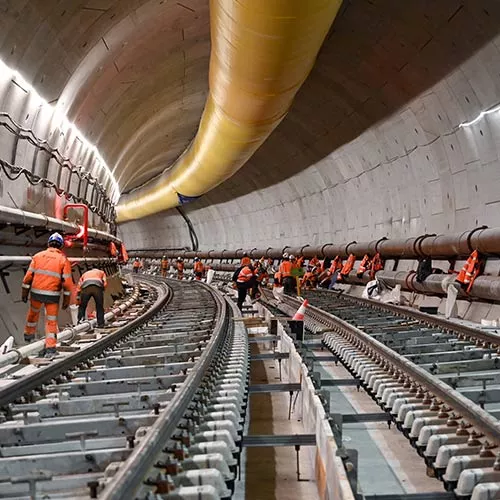
The extension of RER E to the west
Since 6 May 2024, the extension of RER E to the west of Île-de-France region has opened, with a new 8 km underground infrastructure and service to three new stations (Nanterre La Folie, La Défense Grande Arche and Neuilly Porte Maillot) that already accommodate 70,000 passengers a day. Ultimately, EOLE will benefit more than 650,000 passengers a day, and almost 2 million passengers traveling on other lines in the Paris region will enjoy its positive effects.
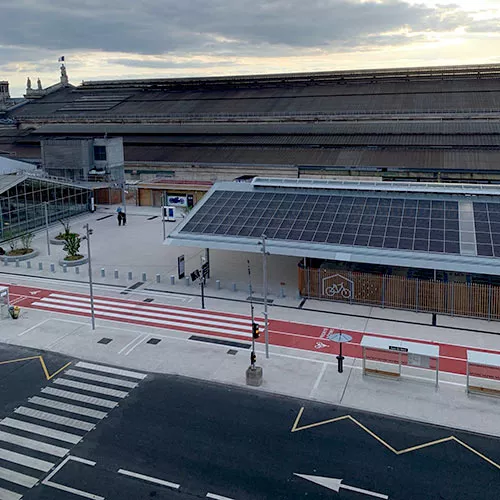
Renovating and modernising our stations
SNCF Gares & Connexions implemented a proactive policy in anticipation of the Paris 2024 Games. This began with the modernisation of Montparnasse and Paris Gare de Lyon stations in 2021, the heritage restoration at Paris Austerlitz and Paris Gare de Lyon at the end of 2023, the metamorphosis of Lyon Part-Dieu, and the first phase of renovations at Paris Gare du Nord.
Developing intermodality was also a key project for SNCF Gares & Connexions, through the deployment of thousands of secure bicycle parking spaces open to all passengers. At Paris Gare du Nord, the largest secure cycle parking facility in the Île-de-France region was created in a large hangar equipped with solar panels and thus self-sufficient in electricity.

6,500
secure bicycle parking spaces created for the Paris 2024 Games

45,500
new bicycle parking spaces in France by the end of 2024
1,200
secure bicycle parking spaces created in Paris Gare du Nord
To our 14 athlètes SNCF: THANK YOU!
Accessibility as a major issue
230 stations made accessible in the Île-de-France region
As part of the regional blueprint for accessibility financed by Île-de-France Mobilités, 230 stations were made accessible in Île-de-France, thus covering 95% of rail traffic in the region. Among the stations made accessible in recent years are Saint-Quentin-en-Yvelines, Saint-Denis, Austerlitz RER, Invalides and Champ de Mars.
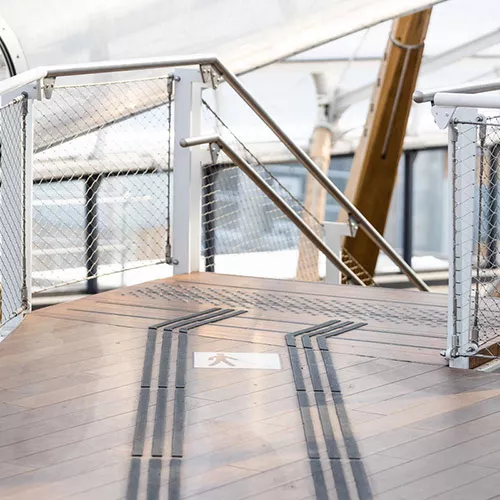
In the run-up to the Paris 2024 Games, the busiest stations during the competitions, both in the Paris region and elsewhere in France, were also improved as their priority facilities were upgraded with:
- tactile warning strips for pedestrians’ safety
- increased visual contrast on stairs and platforms
- improved signage for lifts and assistance meeting points
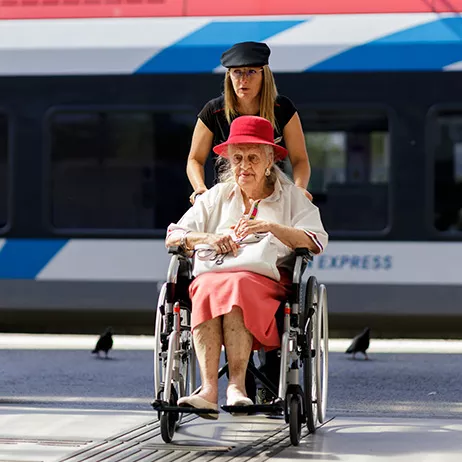
Assist'enGare & Acceo to make everyday life easier
SNCF Gares & Connexions has set up Assist'enGare, a single booking service for assistance services in stations (in French or English), whatever the carrier or type of train used. During the Paris Olympic Games, 97% of users said they were satisfied with the service.
SNCF has also tested and deployed the Acceo tool, which enables station agents to communicate with deaf or hard-of-hearing people thanks to instant speech transcription or through a connection with an interpreter in French Sign Language or in French Cued Speech.
Passenger information: a game changer
A first in Europe
This innovation allows passengers to position themselves on the platform so as to board a less heavily loaded carriage and thus enjoy a comfortable journey. It also enables better management of the flow of passengers boarding and alighting from trains, and optimises train parking times in stations. This large-scale deployment was a first in Europe.
The Paris 2024 Games were also an opportunity for SNCF Voyageurs to speed up the fostering of multilingualism. In trains and stations in the Île-de-France region, as well as on TGVs, passenger information is now available in several languages (French, English, Spanish and Italian), making it easier for everyone to access services.
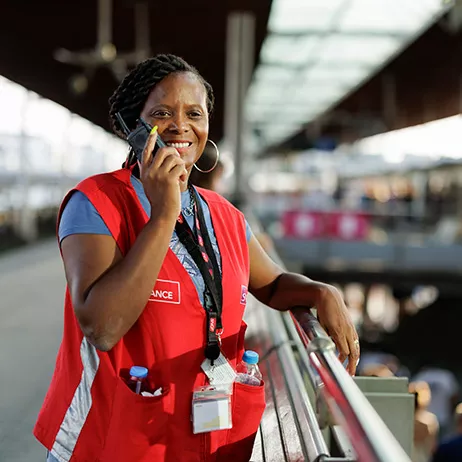
An app to ‘speak’ 130 languages
SNCF has launched Trad SNCF, a translation application available in 130 languages, in order to help, guide and reassure international customers. It is now available to all SNCF staff; they may use their smartphones to translate questions asked by foreign customers at stations or from a distance as well as answers to these requests, thanks to a dependable vocabulary attuned to the rail industry. Finally, SNCF Voyageurs has equipped new trains with audio systems that can be used remotely from the supervision centres to provide live information to customers onboard.
AI to simplify operations in dense urban areas
The Paris 2024 Games have made it possible to adapt certain rail operating rules to dense urban areas (mass transit) in order to avoid as much as possible having to force trains to stop. For example, in the event of people trespassing on the tracks, drivers in the Île-de-France region now may continue to drive ‘cautiously’, if visibility conditions warrant it, whereas previously the rule was to stop trains immediately.
SNCF Réseau has also fast-tracked the development of predictive maintenance for Paris 2024 by deploying a new sensor technology using artificial intelligence. These new sensors incorporate a specially developed algorithm and can detect weak signals in the infrastructure and avoid potential delays. 5,000 measuring points have been deployed in the Île-de-France region, 1,800 more than last year.
Share the article