

France’s latest rail motorway links Luxembourg with the Basque region
VIIA—Rail Logistics Europe’s rail motorway subsidiary—continues to build out its network, with a new line linking Luxembourg and France’s Atlantic coast. Operated by Lorry Rail, the line will simplify cross-border shipping across Europe.
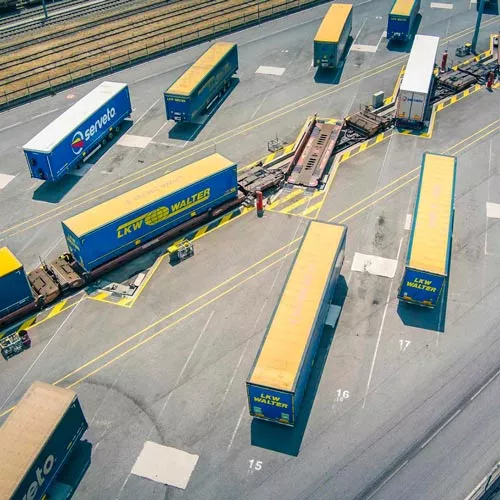
A strategic link between Northern Europe and Western France
At the Mouguerre rail terminal in France’s Pyrénées-Atlantiques department, the same scene plays out four times a week: around 24 semi-trailers and 22 shipping containers are loaded and unloaded horizontally onto long freight trains that ply the route from the Grand Duchy of Luxembourg to the Atlantic coast. This new rail motorway is operated by Lorry Rail, which is partly owned by VIIA, a subsidiary of SNCF Group company Rail Logistics Europe. It offers a multimodal solution for businesses across all sectors seeking high-performance, low-carbon, long-distance transport. The line will facilitate freight flows between southwest France, Portugal and Spain at one end, and the Benelux countries, Germany, Eastern Europe and Scandinavia at the other.

45
semi-trailers and shipping containers per train, thanks to Modalohr1 technology

4
weekly round trips between Bettembourg and Mouguerre

1.4 t
of CO2 emissions avoided for each semi-trailer carried
Efficient transport and lower emissions
Rail motorways cut CO2 emissions by more than 90% compared with road transport, but are just as efficient, particularly over long distances. Every semi-trailer transported by VIIA’s new rail motorway will save 1,424 kg of CO2.
Rail Logistics Europe’s new route—in partnership with VIIA and Lorry Rail—shows that rail motorways are an effective way to ease road traffic and offer carriers a green alternative that’s competitive over long distances.
VIIA CEO
The rail motorway leader
VIIA and its Lorry Rail subsidiary opened their first rail motorway along the Mediterranean coast in 2006 with the Bettembourg-Le Boulou line, which now offers 27 weekly round trips. This major corridor linking Spain and Portugal with Northern and Eastern Europe avoided 144,626,919 kg of CO2 in 2024.