


Orléans–Vierzon line: a new record
In less than five months, SNCF Réseau and TSO teams, responsible for the project, replaced 110 km of rails, equivalent to 55 km of track. This exceptional collective achievement set a new national productivity record.
Record-breaking track renewal
On 17 September 2026, SNCF set a new national record during overnight track renewal works between Orléans and Vierzon, replacing 4,536 meters of track in a single shift.
It was a remarkable achievement on a busy line carrying 70 trains a day: 44 TER regional services, 19 Intercity trains and 7 freight trains. Working under SNCF Réseau supervision, contractor TSO replaced both of the track’s sets of rails along a 2,268-meter stretch, meeting the highest safety and quality standards throughout.
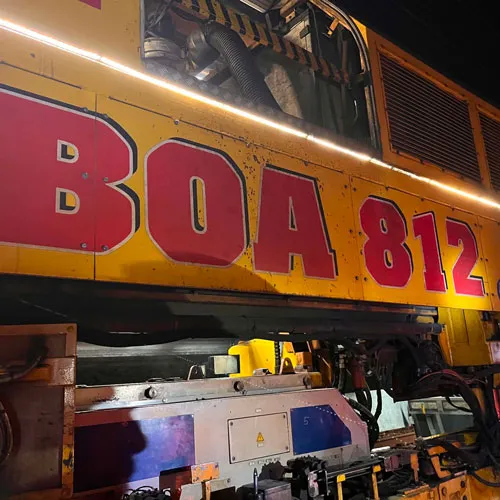
BOA in action
The work was carried out using BOA, a specialized 600-metre-long mobile “factory train” made up of various railway vehicles and equipped with four workstations to:
- unload new rails
- weld new rails
- replace old rails with new ones
- collect and load old rails for recycling

€90 million
Invested by SNCF Réseau in a multi-year upgrade programme

6,500 t
of old rails melted down to make new ones

80 km
of double track renewed between Orléans and Vierzon since 2023
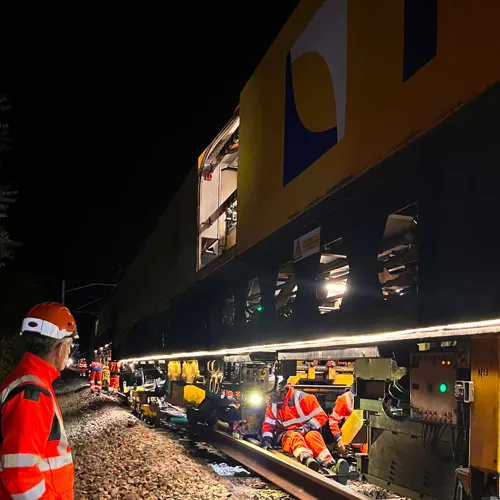
Bringing a project launched in 2023 to completion
The work carried out using BOA was part of a multi-year upgrade on the Orléans-Vierzon line. Summer 2026 works marked the third and final phase, bringing the total length of renewed double track to 80 km. The programme got under way in 2023 between Orléans and Nouan-Le-Fuzelier, then continued in 2024 around La Ferté Saint-Aubin and between Lamotte-Beuvron and Salbris.
Circular economy at the heart of SNCF Réseau’s strategy
All 6,500 tonnes of rails removed were transported by train to the Saarstahl Asoval steelworks in Saint-Saulve, northern France, where they were melted down to produce new rails. The plant recycles old rails and other scrap metal, including materials recovered from the rail network. It uses electric arc furnaces, which consume far less energy and generate up to 90 percent less CO2 than conventional blast furnaces.
Share the article