

RESIST: building more resilient infrastructure
This SNCF Réseau initiative aims to anticipate the impacts of climate change by testing practical solutions today. The goal: a more resilient, sustainable and efficient rail network.
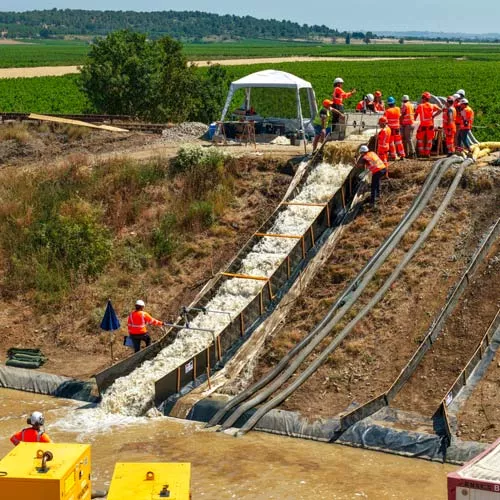
Analyzing the impact of flooding
How can the rail network be adapted to withstand the effects of an increasingly unpredictable climate? Today, we can calculate the temperature of a rail during a heatwave, but we cannot yet predict how an embankment will behave during a flood.
That’s where RESIST comes in. Short for RESilience of [earth] STructures, the project is being conducted in partnership with INRAE, France’s National Research Institute for Agriculture, Food and the Environment. Its aim is to make railway embankments more robust by designing structures capable of withstanding hydraulic stresses, limiting damage and allowing rail traffic to resume quickly after a flood.
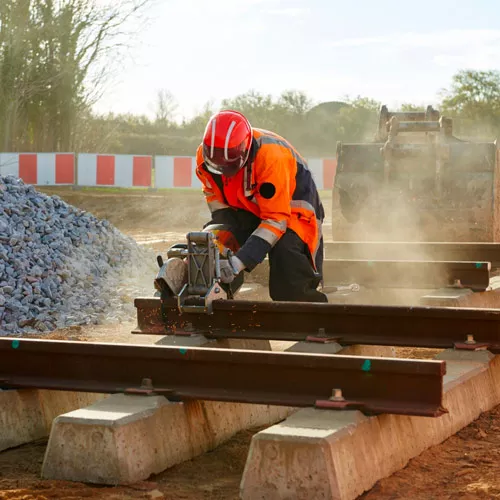
Phase 1—preparatory work
SNCF Réseau began by converting a non-operational section of the Narbonne-Bize line in Occitanie into a dedicated test site equipped with:
- a new 50-cubic-metre supply basin at the foot of the embankment to collect and store the water needed to simulate flood conditions
- track panels installed in the future test channels so that experiments would reproduce the geometry of an real railway.
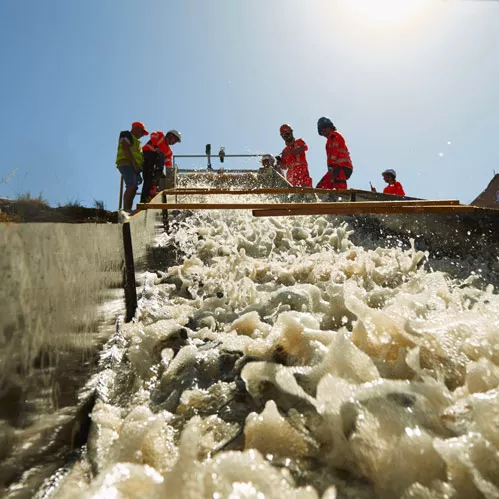
Scaling up—a key stage
In June 2026, the project moved into its experimental phase on this non-operating section of the Narbonne-Bize line two test channels were created at the site to observe how earthworks behave during severe flooding. The aim: to compare theoretical models with real-world conditions and assess how accurately they predict embankment behaviour.
SNCF Réseau teams in action
A wide range of SNCF Réseau staff and technical experts are involved in preparing, carrying out and monitoring the trials. Their focus and expertise are essential to ensuring reliable results—and ultimately to the success of the project.
Share the article