

Unprecedented upgrades to boost rail freight efficiency
We are upgrading four marshalling yards to secure the long-term future of single-wagonload rail freight. This €156 million investment—led by SNCF Réseau, the French State and the European Commission—is a key initiative under France’s National Strategy for Rail Freight Development.
An unprecedented works programme
Increasing the modal share of rail freight is central to the European Union’s and France’s commitment to lower-carbon mobility, as outlined in France’s National Strategy for Rail Freight Development (2021). To support this objective, an ambitious programme of infrastructure upgrades and renovations is underway at four rail freight marshalling yards.
A total of €156 million is being invested in these works, funded by the French State (48%), the European Commission (35%), SNCF Réseau (15%) and local authorities in France’s Sud region (2%). Upgrades focus on the following marshalling yards:
- Woippy, northeastern France
- Sibelin, southeastern France
- Miramas, southern France
- Le Bourget, northeast of Paris
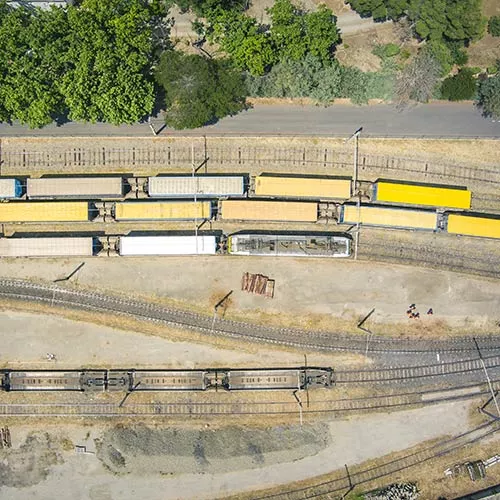
A system for re-marshalling wagons
These four gravity marshalling yards are purpose-built for single-wagonload rail freight. Their sorting system allows wagon rakes to be broken down and reconfigured to form new, complete trains, known as block trains. Infrastructure upgrades—essential for smooth and efficient marshalling operations—have already begun at Woippy and Le Bourget.

1
freight train = 40 HGVs
1,100
freight trains operate daily on France’s rail network

€156 m
invested to modernize 4 gravity marshalling yards
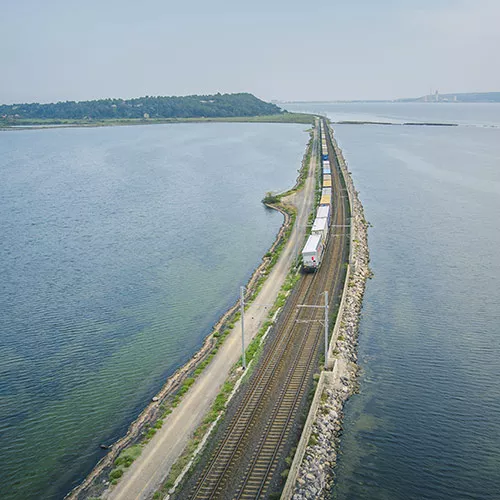
An efficient driver of lower-carbon freight logistics
Rail is one of the most effective ways to decarbonize freight transport. A single freight train can carry the same load as 40 heavy goods vehicles (HGVs) while emitting 9 times less CO2. Each day around 1,100 freight trains circulate on France’s rail network, supporting three core delivery modes:
- Combined transport: Freight containers are transferred between rail, road, ports and inland waterways via logistics terminals.
- Block train transport: Full trains operate directly between shippers and receivers, using private sidings linked to the national rail network.
- Single-wagonload transport: Individual wagons are assembled into trains at departure and re-sorted on arrival at marshalling yards.
Share the article