

Connecting regions across France: Haut-de-France
Find out how we support tens of thousands of jobs in the region and work with all our stakeholders to make lives better
We contribute to the region’s economic growth

20,132
SNCF Group employees in 2025

27,850
other local jobs supported in 2025

€2.2bn
in purchases from local suppliers in 2025
Rail freight—18% of total land-based cargo transport
In Hauts-de-France, rail freight transports 18% of all land-based cargo—double the national average.
Expanding access and service at the Port of Calais
We’re upgrading a 4.4-km stretch of railway between Calais-Ville station and the Dunes rail yard, a vital link connecting the port of Calais to the wider rail network. Freight trains currently make 3-4 return trips a day between the port and Calais-Ville station. Our goal is to raise this to 15 by 2040. Network operator SNCF Réseau is the contracting authority for this project, with key upgrades including track renewal and the installation of noise barriers. The first phase was completed in June 2025 as part of an €83 million package co-funded by the French State (81%) and the Hauts-de-France region (19%).
Actively enhancing quality of life in the region

Delivering healthcare through a nursing centre at Soissons station
Fifteen nurses, a secretary and a coordinating nurse from AMSAM, the Association Médico-Sociale Anne Morgan, are now working from a 96 sq. m. nursing hub at Soissons rail station. This non-profit organization offers 14 medical services including home healthcare and nursing, care for Alzheimer’s patients, support for marginalized populations, promoting health and self-care, housing solutions ranging from independent residences to emergency accommodation.
In recent years, AMSAM has prioritized practice-based nursing solutions to better meet the needs of local residents. And basing operations at Soissons station in premises managed by SNCF Gares & Connexions, our station management subsidiary, is one way to serve the community more effectively.
Replacing diesel engines with batteries
In partnership with Alstom and five regional partners, including Hauts-de-France, SNCF Voyageurs has launched tests of battery-powered TER regional trains. The aim is to replace bi-modal trainsets that use power supplied by catenaries and thermal engines with fully electric models, replacing thermal engines with lithium-ion batteries. Commercial service will start soon on a trial basis in the region.

Powering homes with a mobile solar plant
At Lille Mont-de-Terre, we’re conducting trials with a mobile solar plant installed on a disused railway site. The system is connected to a nearby residence managed by ICF Habitat, an SNCF subsidiary managing social housing. The solar plant supplies 100% renewable energy directly to the building’s communal areas, with all electricity generated on site. It’s a ground-breaking initiative that highlights SNCF Immobilier’s commitment to advancing the energy transition through sustainable living solutions.
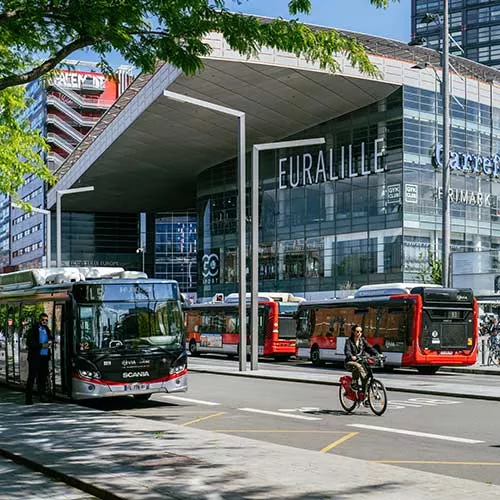
Making urban travel easier for everyone
Keolis, an SNCF subsidiary and global leader in shared mobility, is transforming transportation in the Hauts-de-France region. The company operates and maintains Lille’s Ilevia network, offering a wide range of transport options to meet residents’ needs—from metros, trams and buses to on-demand transport, solutions for people with reduced mobility (PRM), V’Lille self-service bike rentals and more.
With the renewal of a 7-year contract by the local Mobility Organizing Authority, Keolis is set to further enhance travel options for residents across Lille’s 95 communes.
A multimodal network for Amiens residents
Greater Amiens has awarded Keolis a new 6-year contract—through 2031—to operate and manage the Ametis transport network serving the metropolitan area.
Under this €245 million contract, Keolis aims to deliver sustainable, innovative and ever more efficient mobility solutions to the city’s 180,000 inhabitants and visitors.
We’re supporting the rollout of metropolitan regional express services (SERM)
Our SNCF Réseau and SNCF Gares & Connexions teams are active members of the SERM Hauts-de-France project. Short for Service Express Régional Métropolitain, SERM is designed to ease road congestion and travel for 5 million people in the Flanders, Calais, Valenciennes, Douais, Cambrésis and Arrageois regions by offering practical solutions based on a modal shift to rail.
The project calls for doubling rail capacity, with up to 8 trains an hour, and extending train service hours from 5 am to 11 pm. The SERM project also includes developing a new Hauts-de-France express network, building a 40-km rail line between Lille and Hénin-Beaumont, and creating a new city-centre station in Lille.
Teaching rail safety to youngsters
During the 2025/2026 school year, 5,500 children—from kindergarten through secondary school—took part in our rail safety classroom sessions, offered across the region.
Modernizing the rail network
SNCF Réseau is funding major track and infrastructure works in Hauts-de-France to upgrade the entire system.
Share the article