

Innovations that improve network monitoring
Autonomous mobility, cameras and high-performance lasers—we’re building innovative, alternative ways to inspect tracks and catenaries. The goal? Better infrastructure monitoring at a lower cost.
The SNCF railway network includes 28,000 km of tracks and 33,000 km of catenaries—the overhead lines that deliver electricity to trains. SNCF Réseau monitors that infrastructure around the clock to ensure trains run safely and reliably. But that level of monitoring is costly and energy-intensive, which is why we’re developing new, more technologically advanced ways to get the job done.
The MARS LGV project
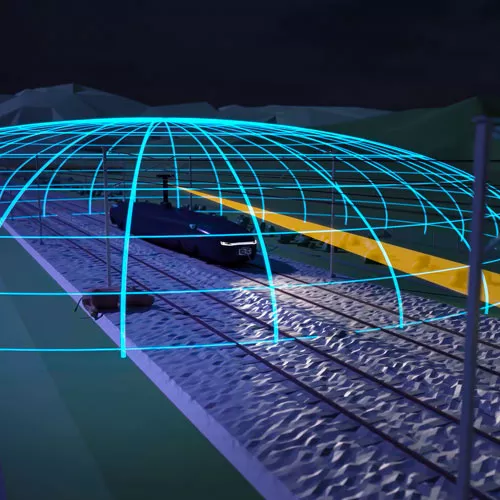
A ground-breaking system for high-speed lines
Every day, we send out empty TGV trainsets to check the tracks for anomalies before our high-speed services carry passengers. It’s effective, but expensive and consumes a lot of energy, so we’ve been researching technology-led alternatives for this vital mission.
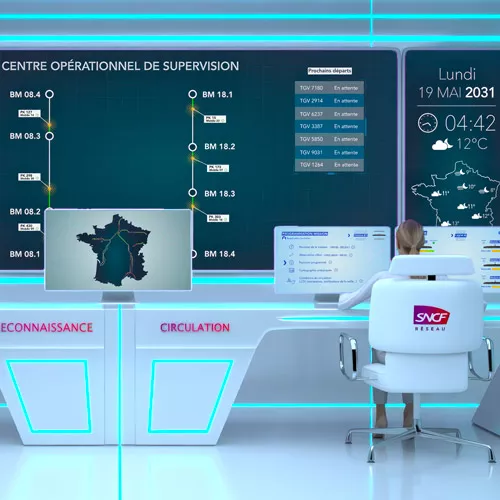
Making day-to-day monitoring easier
That’s the goal of SNCF Réseau’s MARS LGV project; MARS stands for Autonomous Mobile Safety Reconnaissance. The project’s GoA4 autonomous, battery-powered units can patrol every kilometre of high-speed track, capturing 360 imagery via sensors, radar, cameras, lidar and on-board systems, with data streamed to an operations centre in real time. Ground teams can respond as soon as an anomaly is detected.
Each unit has a home charging station and a coverage area defined by its range. Charging-station locations are planned to maximize flexibility and optimize reconnaissance times, during the least disruptive working hours.

What MARS LGV does better
- Environmentally: 20 times less energy consumption, with low-carbon mobile units designed for sustainability.
- Scientifically: Innovative technologies with potential applications across other areas of railway operations, improving overall network security.
- Economically: Monitoring costs 3 times lower.
Lastly, it frees TGV trainsets up to do what they’re meant to do—carry passengers.
Project partners and financing
The MARS LGV development project, scheduled for completion in 2029, is a collaboration between six partners:
- Forsee Power
- Compagnie des Signaux
- IRT Railenium
- Socofer France
- Spirops
- SNCF Réseau, with support from SNCF’s Technology, Innovation and Group Projects Division.
It also has backing from the French State thanks to an application submitted—supported by Bpifrance—to CORIFER’s 2023 call for expressions of interest under the France 2030 investment programme.
CAMESCAT
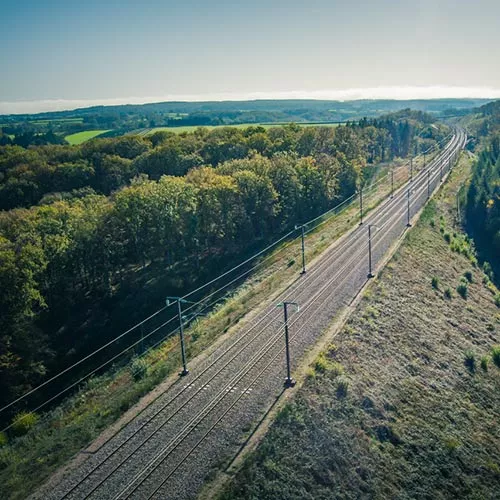
Laser sentries for catenaries
Did you know? 33,000 km of catenaries supply electricity through pantographs mounted on nearly all the trains on our network. Overhead lines wear out over time and need regular inspection. Until now, inspections have relied on slow-moving, specialized vehicles equipped with measuring apparatuses using optical profilometry1 and shadowgraphy2.
Two lasers, 6,000 images per second
The CAMESCAT project—an anagram for catenary section measurement sensor—also uses profilometry. Its two lasers can produce up to 6,000 images per second and measure a cable’s diameter to within a half millimetre. And do so at 120 km/h!
minutes lost per catenary incident, on average
Ready for the real world
Extensive work went into validating concepts and securing approval for a system that mounts cameras and lasers on a pantograph close to the catenary contact wires. The data are stored in servers aboard the train for teams to analyze once a run is complete.
After two years of fine-tuning, the CAMESCAT system entered pre-production in February 2025, installed on a UFM160 train operated by Eurailscout France3 under the direction of the SNCF Réseau Operations and Production team.
An environmentally sound approach
Beyond its ability to slot in with regular traffic and cover high-speed lines, taking measurements at 120 km/h, CAMESCAT helps SNCF use copper more efficiently. Copper is used to repair catenaries, and the new system allows us to target segments more precisely, replacing only those with significant wear.
CAMESCAT will enable SNCF Réseau to cut costs while improving network performance and sustainability. That’s a winning formula now attracting attention from other rail operators across Europe who share those goals.